A region expands into a new market. A business unit selects an AI platform. A leadership team responds to a competitor move.
Each decision may make sense on its own. But is anything connecting them?
In many established organizations, the honest answer is: not clearly enough. Important decisions are made every day, but without a continuous strategy capability to connect them, it becomes difficult to know which ones truly move the business forward. That fragmentation has always been costly. In the age of AI, it is becoming a competitive liability.
What is missing is not another planning cycle. It is a continuous strategy discipline aligned with how the business needs to deliver, compete, and grow.
In many technology companies, strategy is treated as a core operating muscle. Product roadmaps, platform choices, customer priorities, partnerships, and investment decisions are reviewed continuously as markets evolve. Leadership teams do not wait for an annual planning cycle to revisit strategic assumptions.
Many traditional industries operate differently.
In sectors such as architecture, engineering & construction (AEC), healthcare, industrial manufacturing, agriculture, logistics, utilities, and traditional professional services, strategy is often more fragmented. It may sit within business units, geographies, operations, annual planning, or major client relationships. Important decisions are made every day, but they are not always connected through a clear enterprise-wide process.
That gap matters more now because AI is changing the speed, cost, and scale of work.
AI is helping companies automate tasks, accelerate analysis, improve workflows, support customers, and operate with leaner teams. About 20% of U.S. businesses are already using AI, with adoption higher among larger firms.
But efficiency is only part of the story.
Smaller, more focused competitors can now access capabilities that were once available mainly to larger firms with deeper benches, larger budgets, and more specialized teams. That changes the basis of competition.
For established companies, this creates both a concern and an opportunity. The concern: AI can erode advantages incumbents have historically relied on – scale, institutional knowledge, long-standing client relationships, and specialized expertise. The opportunity: those same incumbents can combine their domain depth with stronger enterprise-wide strategy to redefine how they compete.
But that opportunity does not capture itself. It requires a different kind of strategic discipline.
Why This Matters for AEC (Architecture, Engineering & Construction) More Than Ever
AEC firms are built on expertise. Their value comes from technical judgment, project experience, client trust, local market knowledge, and the ability to coordinate complex work across disciplines.
Large firms have historically benefited from scale: deeper benches, broader reach, specialized talent, stronger resumes, and the ability to pursue larger projects. That scale has mattered even more in a constrained talent market. Roughly 1 in 3 new U.S. engineering roles go unfilled each year because demand is outpacing the supply of new engineers.
But AI is beginning to shift that equation.
Technology can now help smaller firms accelerate proposals, automate routine analysis, summarize technical information, improve project controls, support design workflows, and scale knowledge across leaner teams. These tools do not replace deep expertise, but they reduce the advantage that size alone once provided.
For large firms, scale remains valuable. But scale alone is not a strategy.
I recently spoke with a C-suite leader at a large, established architecture and engineering consulting firm with a national footprint and multi-decade history. The conversation was not simply about adopting AI tools. It was about something more fundamental: how does a firm of that scale build the enterprise-wide strategy capability needed to grow, compete, and rethink how work gets done?
That conversation reflects a broader challenge across many established companies.
Many organizations have grown through long-standing customer relationships, repeat business, regional teams, functional expertise, and business-unit autonomy. That model has real strengths. It keeps teams close to customers and markets.
But as companies scale, the same model can create fragmentation. Priorities become inconsistent. Capabilities are duplicated. Collaboration becomes harder. Investment decisions become disconnected. The organization can drift into a reactive posture – responding to customer requests, RFPs, market pressure, or competitor moves rather than proactively shaping where the business is headed. In the AI era, that reactive posture is no longer a sustainable position.
What Best-in-Class Companies Do Differently
They manage strategy as a continuous enterprise discipline, anchored by five core practices:
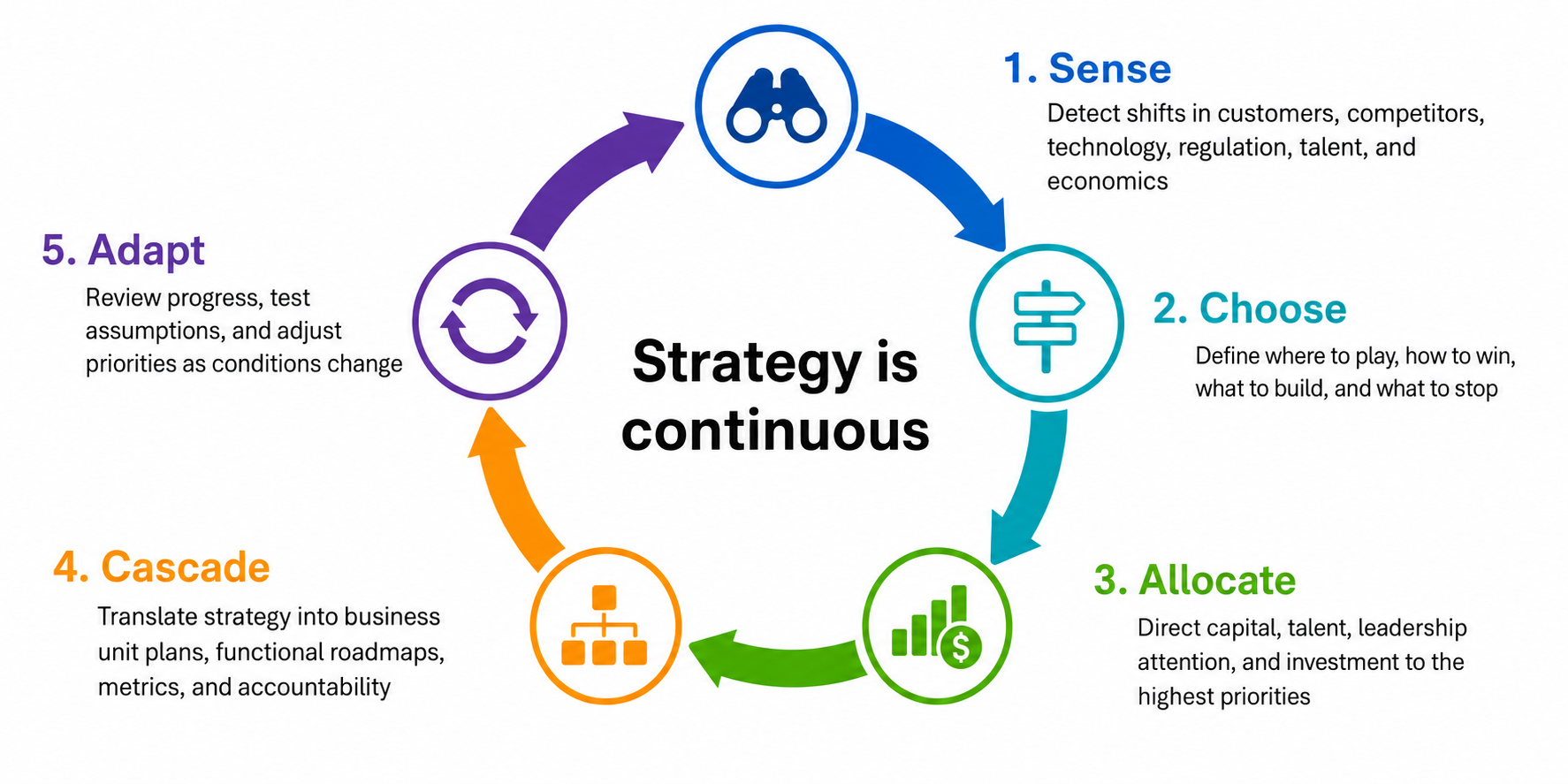
They continuously Sense market shifts, Choose where to play and how to win, Allocate resources to the highest priorities, Cascade those priorities across the business, and Adapt through a regular cadence.
The goal is not to copy technology-company culture. It is to combine domain discipline with strategic speed.
AEC, infrastructure, healthcare, logistics, manufacturing, agriculture, and utilities are risk-aware for good reason. These industries cannot simply adopt a “move fast and break things” mindset. The goal is to build a strategy cadence that respects domain expertise while helping the organization become more proactive, analytical, collaborative, and future-ready.
How Clarity Beacon Consulting Can Help
At Clarity Beacon Consulting, we help business leaders build the strategy muscle required for the AI era.
We partner with companies to answer four critical questions: where to play, how to win, what capabilities to build, and how to execute at scale. Our work brings together enterprise strategy, growth strategy, market and competitive intelligence, AI-enabled value creation, operating model design, governance, resource allocation, and execution roadmaps – helping leaders move from fragmented priorities to clear choices, aligned resources, and enterprise-wide action.
Contact us or email info@claritybeaconconsulting.com to start building your enterprise strategy for the AI era.